How We Built TekeraLab’s Four-Language Blog Workflow
A behind-the-scenes look at the publishing workflow that connects writing, translation, SEO, author attribution, preview, and live verification across English, Turkish, Persian, and Arabic.
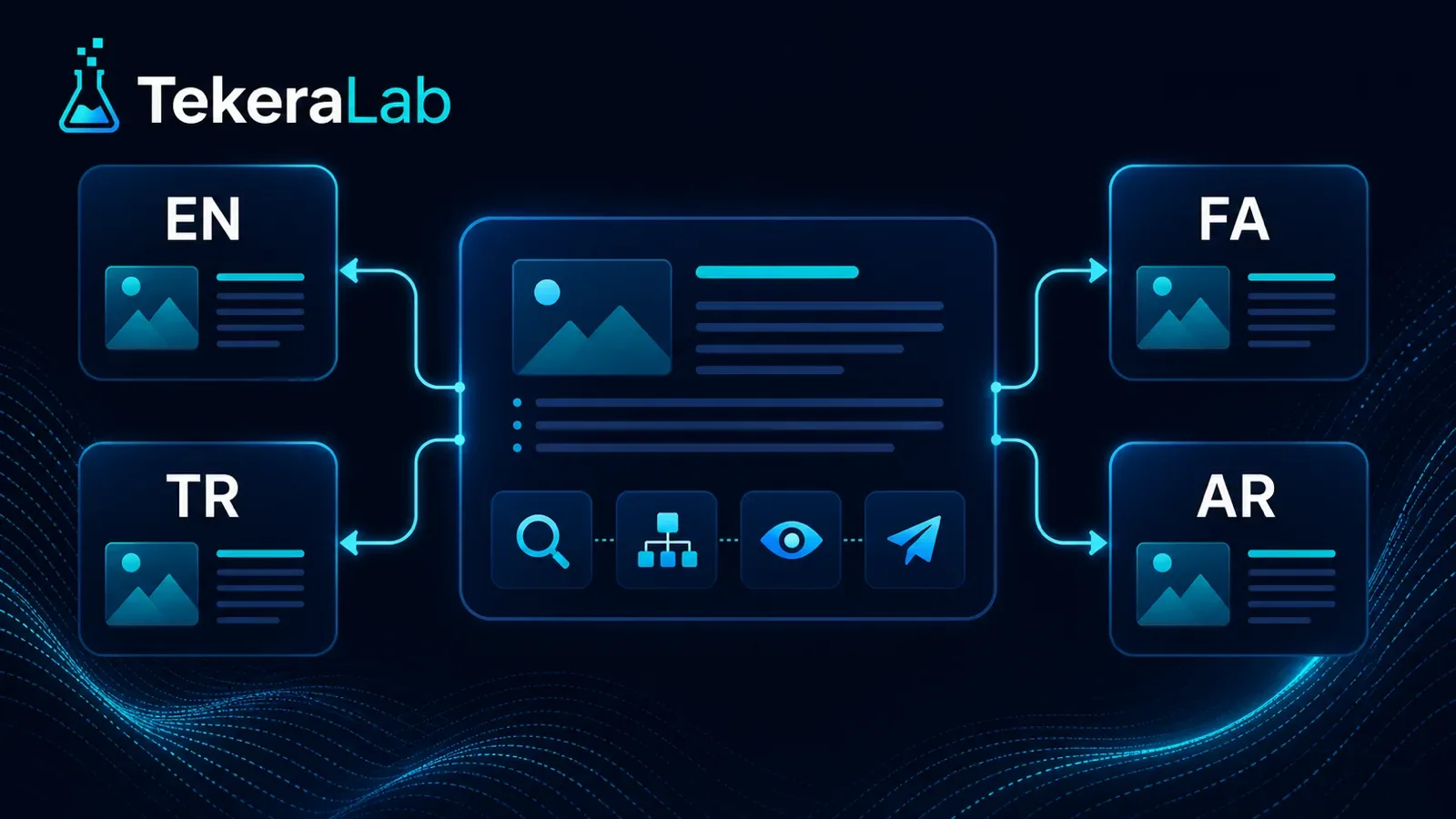
Publishing the same story in four languages sounds simple until the first real article reaches the editor. Translating the text is only one part of the work. The language versions must belong to the same story, each page needs its own search metadata, and the final result has to work for readers on the public site—not only inside an admin panel.
We built TekeraLab’s blog workflow around that complete path. One place now connects writing, translation, SEO controls, author attribution, preview, publishing, and post-publication verification for English, Turkish, Persian, and Arabic.
The problem was bigger than translation
Four copied records are not a multilingual publishing system. If the pages do not know that they are translations of one source, readers and search engines receive four disconnected documents. That can lead to missing language alternatives, the wrong canonical URL, or a translation that silently falls behind the source.
Our workflow starts with an English source and links Turkish, Persian, and Arabic versions to it. Each locale keeps its own title, excerpt, body, canonical URL, image alt text, and social metadata while remaining part of the same translation family.
SEO controls belong beside the article
SEO becomes unreliable when it is treated as a separate task after publication. The editor therefore keeps the SEO title, description, primary keyword, canonical URL, cover image, social image, localized alt text, and tags beside the article itself.
The panel also shows a deterministic preview of the canonical URL, language alternatives, social image metadata, and Article and Breadcrumb structured data. That does not replace a live check, but it makes missing fields visible before publication.
Links are part of the reading experience too. A product or internal link should be visibly clickable for the reader, not hidden as an SEO-only signal. You can see the result throughout the TekeraLab blog, where linked phrases are visually distinct from surrounding text.
Four languages, one article family
A complete translation includes more than headings and paragraphs. Link labels, calls to action, image descriptions, SEO fields, and social preview text must also match the page language. Persian and Arabic additionally need correct right-to-left rendering on desktop and mobile.
The translation relationship lets every page publish a self-referencing canonical URL while also listing reciprocal alternatives for English, Turkish, Persian, and Arabic, plus an English x-default. Readers can switch languages, and search engines can understand which page belongs to which audience.
Preview first, publish deliberately
Before an article goes live, we inspect the visitor preview—not only the editor fields. The cover must load, headings must form a clear hierarchy, links must reach the intended pages, and the AI-assistance disclosure must appear in the correct language.
Publishing also requires an explicit confirmation. After publication, we check the four public URLs, the blog index, the category page, the sitemap, canonical and hreflang tags, structured data, images, and right-to-left layout. A green indicator in the panel is useful, but the public page is the final evidence.
What this changed for daily publishing
The biggest improvement is not a single button. It is the removal of scattered handoffs. An editor can prepare a story, connect its translations, manage the metadata, inspect the visitor view, and publish through one controlled workflow.
That makes routine publishing faster without lowering the standard. The system still asks for evidence, language-specific review, and a final live check. It simply keeps those responsibilities visible and connected.
A good publishing system does more than store text. It preserves the relationship between language, meaning, metadata, attribution, and the page the reader actually sees.
For the longer story of why TekeraLab exists at all, read about the marketplace, virtual-commerce and fashion-store projects that came before TekeraLab.
Ask a question
Got a question about this post? Drop your email and we’ll reply.
Get notified of new posts
1–2 emails a month on social media, AI and running a small business. No spam.
Related posts

Don’t Delete Test Data—Separate It from Real Revenue
Hiding test data makes defects invisible; counting it in KPIs corrupts decisions. The solution is to separate visibility from revenue recognition.

The Invisible Revenue Funnel Stage: Where Payments Disappear
Between payment intent and recognized revenue, customers can disappear into untracked states. Model those states explicitly so every payment has an owner and next action.

When an AI Agent Checks Its Own Evidence: How to Build Truly Independent Evaluation
When an evaluator trusts an agent's own report, it may validate the claim instead of the result. This guide separates execution, evidence collection, and evaluation.