A Customer Returned and We Missed It: Why Analytics Needs an Alert Loop
We had GA4, Search Console and Clarity, yet we noticed an important return visit too late. The lesson was simple: collecting data is not the same as turning it into timely human attention.
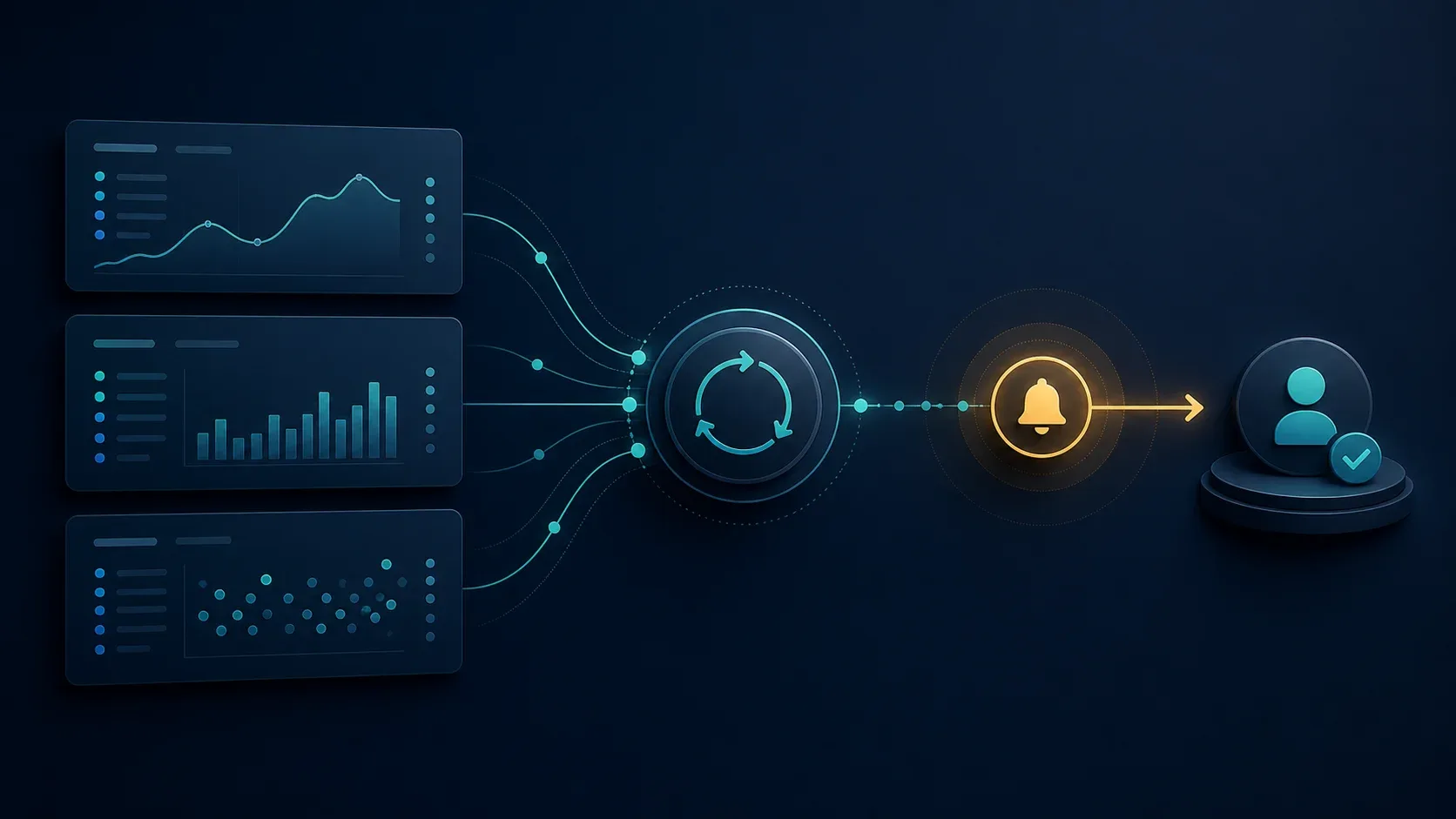
The problem was not a lack of data
A small team can install several analytics tools and still notice an important moment too late. That happened at TekeraLab: a relevant business visitor returned to our website, but the team understood the importance of that return only after the person contacted us through another channel. The data existed. Timely attention did not.
This story is not about the visitor’s identity, location or private browsing path. Those details are unnecessary and should remain private. The useful lesson is broader: recording an event and turning it into an actionable signal are two different jobs.
What do the three analytics tools actually see?
Google Analytics 4, or GA4, measures aggregate traffic and behaviour such as users, sessions, viewed pages and acquisition channels. Google Search Console provides a different view: how a site appears in Google Search, which pages earn impressions and clicks, and which queries are reported.
Microsoft Clarity focuses more on the experience inside the page. Metrics such as scroll depth, dead clicks, rage clicks and other behavioural patterns can reveal where visitors struggle. The three tools do not replace one another; each illuminates a different part of the journey.
Even with all three installed, one operational question remains: who should see the result, and when? Without a clear answer, dashboards become an archive of yesterday’s events.
The real gap was between collection and attention
Our review showed that the issue was not one broken integration. Some data was collected but never entered the daily brief. One report depended on a source that did not produce reliable output. Some Search Console totals were also lost when the process kept only rows that included a visible query, even though Google can hide queries for privacy.
This is a common problem for small teams. Installing measurement tools is a technical project; building a habit of observation and response is an operational system. If those two parts are disconnected, the number of dashboards grows while decision speed does not.
We split the response into two loops
The first loop is a daily brief. It places results from GA4, Search Console and Clarity in one readable summary. When a source is unavailable, the brief says so explicitly. Missing data is not displayed as zero, because zero is a measurement while unavailable means the result is unknown.
The second loop watches GA4 Realtime at short intervals. When a new presence matches the internal rules, it creates a limited, deduplicated alert for the team. The signal can also be heard in Jarvis.app, an internal local assistant used by TekeraLab on a Mac; Jarvis.app is not presented here as a separate public product.
Deduplication and exclusion of the team’s own known traffic are part of the design. The goal is not to turn every fluctuation into an alarm. The goal is to surface a meaningful event early enough for a human to decide what to do next.
What this system does not do
An alert does not create a sale, identify a customer or replace a human conversation. It only says that something may deserve attention. Deciding whether the event represents a genuine business opportunity still requires more evidence and human judgement.
The loop is also not an excuse to collect unlimited personal information. For daily decisions, aggregate metrics, timestamps, source health and a high-level path are usually enough. Phone numbers, identities, precise locations, message contents and private routes do not belong in a public report.
A practical lesson for small teams
If your website already uses GA4, Search Console or Clarity, the first question is not whether to install another tool. Ask who reads the report, when it arrives, how a broken source is exposed and which events truly deserve a faster alert.
A simple loop can have four stages: measure, summarise, alert and make a human decision. Each stage needs its own evidence and status. When one stage fails, the system should expose the gap instead of staying silent and presenting a reassuring but inaccurate picture.
Our experience showed that progress does not always begin with another AI model or dashboard. Sometimes the most valuable change is getting existing data to the right person, with the right explanation, at the right time.
Conclusion
We moved our analytics from a collection of separate screens toward an internal loop of observation, alerting and human action. The system is not a standalone public product and it does not guarantee a business result. It addresses one concrete problem: data that already exists should not be discovered only after the useful moment has passed.
Ask a question
Got a question about this post? Drop your email and we’ll reply.
Get notified of new posts
1–2 emails a month on social media, AI and running a small business. No spam.
Related posts

Don’t Delete Test Data—Separate It from Real Revenue
Hiding test data makes defects invisible; counting it in KPIs corrupts decisions. The solution is to separate visibility from revenue recognition.
The Invisible Revenue Funnel Stage: Where Payments Disappear
Between payment intent and recognized revenue, customers can disappear into untracked states. Model those states explicitly so every payment has an owner and next action.

When an AI Agent Checks Its Own Evidence: How to Build Truly Independent Evaluation
When an evaluator trusts an agent's own report, it may validate the claim instead of the result. This guide separates execution, evidence collection, and evaluation.